Milky Toners Are Back — The Toner-Lotion Hybrid Explained
⚡ The 30-Second Version
- ✓Milky toners — a lotion-toner hybrid that leaves a visible film rather than absorbing like water — are 2026's answer to the drying, astringent toners of the past.
- ✓The science underneath them is the same humectant/barrier logic behind hyaluronic acid and ceramide skincare generally: hydration needs to be layered onto skin and then sealed, not just splashed on and left to evaporate.
- ✓There's no dedicated clinical trial on 'milky toners' as a category — the evidence case rests on the established humectant and barrier-lipid science of their actual ingredients, not the format itself.
- ✓If your current toner leaves skin feeling tight or dry, a milky toner is a reasonable, low-risk swap — just don't expect it to outperform a well-formulated essence or serum doing the same hydrating job.
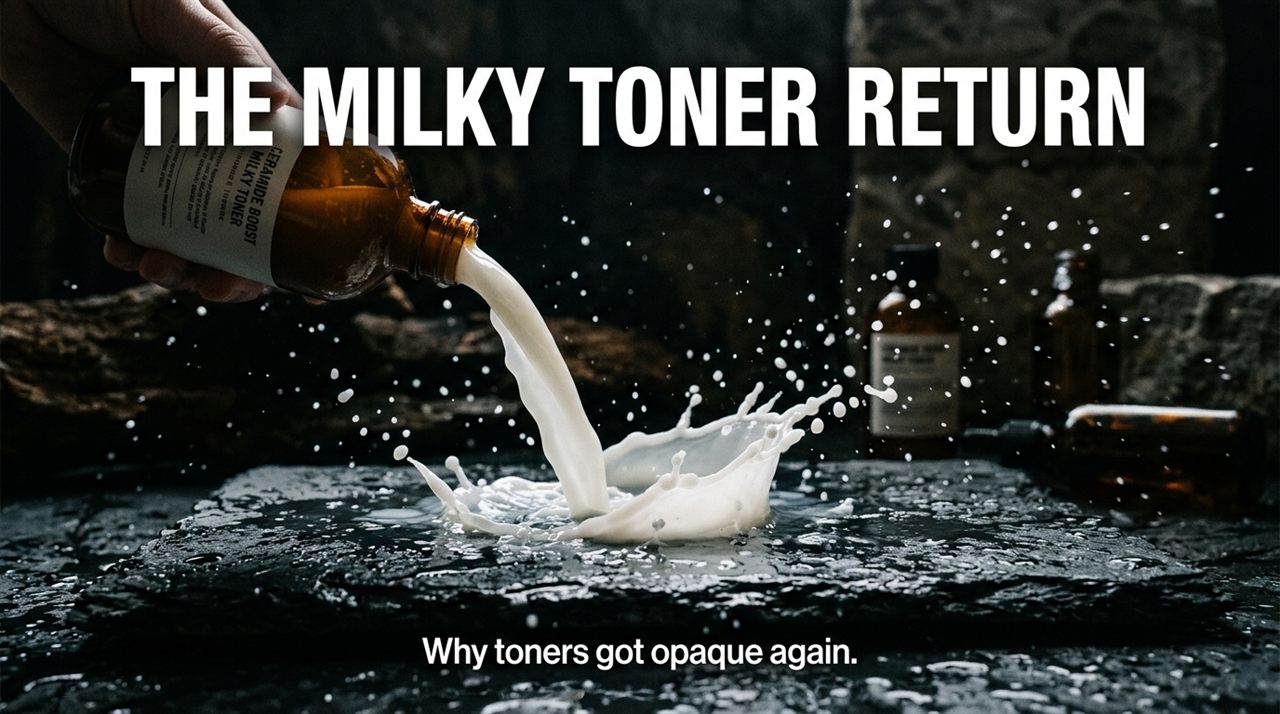
Toners used to mean one of two things: a stinging astringent that promised to 'close pores' (it doesn't — pores don't have muscles to close), or a thin, water-like pass meant to 'prep' skin before the real products. 2026's milky toner trend is neither — it's a visibly opaque, lotion-like formula that leaves a soft film on skin rather than disappearing instantly, positioned as a genuine hydration step rather than a prep step.
Why the format actually makes sense
The logic behind milky toners isn't new science dressed up in new packaging — it's the same humectant and barrier-lipid principle behind hyaluronic acid serums and ceramide moisturizers generally, just delivered earlier in the routine. A well-cited dermatology review describes hyaluronic acid as a key molecule in skin hydration precisely because of its water-binding, humectant properties — but humectants need something to actually hold onto, and a lightweight, milky formula applied right after cleansing (while skin still has some residual moisture) sets up exactly the damp-skin conditions that make humectant ingredients work as intended, rather than pulling moisture out of dry skin the way we've covered can happen with hyaluronic acid applied incorrectly.
The honest evidence caveat
There is no dedicated clinical trial testing 'milky toner' as its own category — it's a format, not an active ingredient, so there's nothing specific to test. The evidence case for milky toners rests entirely on the established science of what's actually inside them: humectants like hyaluronic acid and glycerin, and often a small amount of ceramides or fatty acids to help seal that hydration in. A milky toner with those ingredients is credible because those ingredients are credible — the 'milky' texture itself is a delivery and sensory choice, not a mechanism with its own trial data.
What makes a milky toner different from a regular toner
The formulation difference is real: traditional toners were often alcohol-based astringents designed to strip excess oil, while milky toners are built more like a very lightweight lotion — humectants plus a small amount of emollient, with little to no alcohol. That's a meaningful shift for anyone whose skin got worse, not better, after years of astringent toners, since alcohol-forward formulas can actively damage the barrier they were marketed to improve.
Who this is actually for
If your skin runs dry, sensitive, or barrier-compromised, a milky toner like THAYERS' Milky Face Toner with hyaluronic acid is a reasonable, low-risk swap for an astringent formula — apply it to slightly damp skin right after cleansing, then follow with your usual serum and moisturizer to lock the hydration in, the same sequencing logic behind skin flooding. If your skin runs oily or acne-prone, you likely don't need this extra step — a well-formulated moisturizer is doing the same humectant job without an additional product.
The bottom line: milky toners aren't a new discovery, they're a smarter delivery format for well-established humectant science, replacing the alcohol-heavy astringent toners that used to dominate the category. Worth trying if your current toner leaves skin feeling tight — not a must-have if your routine already hydrates well without it.
Heads up: links below are affiliate links — we may earn a small commission at no extra cost to you. Learn more.
🛒 Featured in this post
 Amazon
THAYERS Milky Face Toner with Snow Mushroom & Hyaluronic Acid
The viral 'milky toner' — a lotion-toner hybrid that forms a hydration layer instead of a thin water pass. 6,800+ reviews, Amazon's Choice.
 Amazon
Illiyoon Ceramide Ato Concentrate Cream
A Korean ceramide-rich barrier cream built for sensitive, reactive skin — the moisturizer layer for sandwiching retinol on beginner or easily-irritated skin.
📚 Sources & studies
- Papakonstantinou E et al., Dermato-Endocrinology (2012) — Hyaluronic acid: A key molecule in skin aging View study ↗
This article is for informational purposes only and is not medical advice. Skincare products affect individuals differently — consult a board-certified dermatologist for concerns about your skin.