Why Does Vitamin C Serum Turn Orange? (And Should You Throw It Out?)
⚡ The 30-Second Version
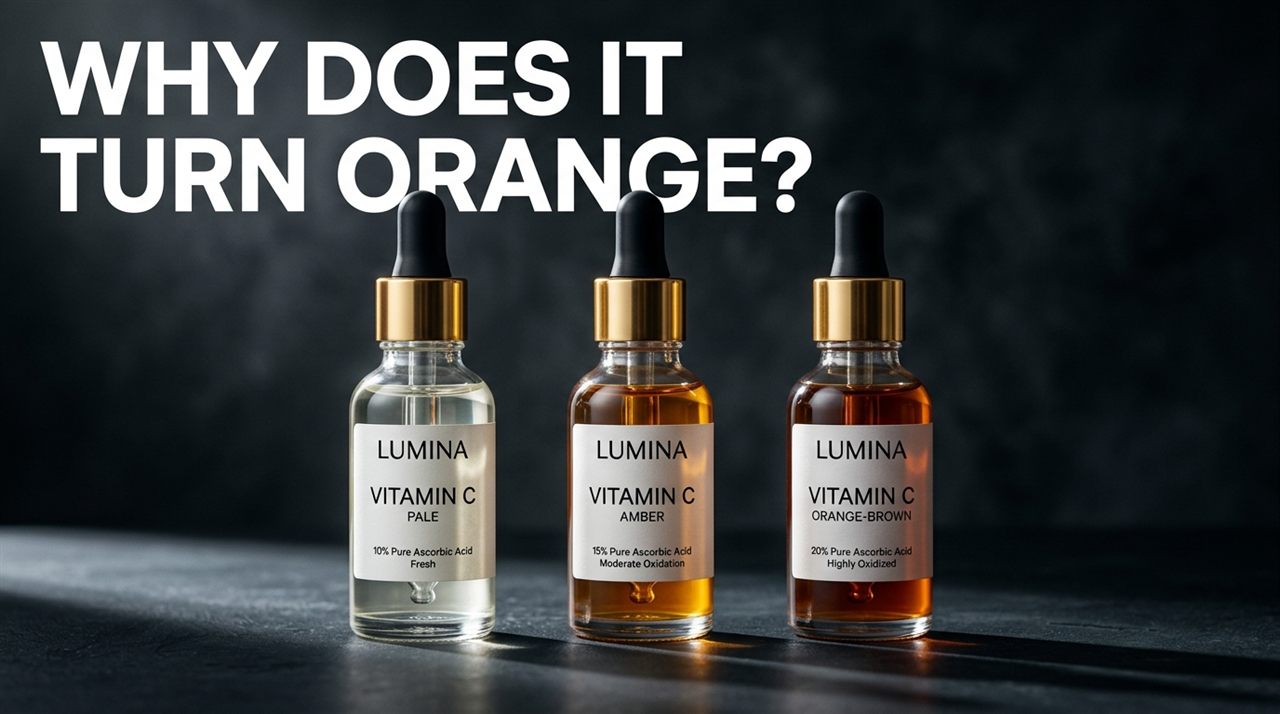
- ✓That color change is real chemistry, not your imagination: L-ascorbic acid (the active, effective form of vitamin C) oxidizes on contact with air, light, and heat, first turning pale yellow, then amber, then orange or brown as it degrades.
- ✓Color roughly tracks potency: pale yellow still has meaningful antioxidant activity left, but deep amber, orange, or brown means the vitamin C has substantially broken down and is doing much less for your skin.
- ✓L-ascorbic acid only absorbs into skin when formulated at a low pH (under 3.5) — which is exactly the chemical environment that also makes it fragile and prone to oxidizing fast. The instability is a side effect of the formulation that makes it work in the first place.
- ✓Slow the clock: keep it in a dark or opaque bottle, store it somewhere cool and out of direct light, cap it tightly after every use, and expect roughly 60–90 days of real potency once opened — sooner if it's in a clear jar that gets sun exposure.
You bought a vitamin C serum because it promised brighter, more even skin — and two months in, you notice the crystal-clear liquid has quietly turned the color of apple juice. Is it still working? Did you waste $20? The color change is not your imagination and it's not a flaw unique to your bottle. It's the active ingredient itself falling apart, and understanding why actually tells you how to slow it down.
The chemistry behind the color change
The gold-standard, most-studied form of vitamin C in skincare is L-ascorbic acid — plain, unbuffered ascorbic acid, not one of its gentler derivatives. L-ascorbic acid is a genuinely unstable molecule once it's dissolved in a formula and exposed to the outside world. On contact with oxygen, light, or heat, it undergoes oxidation: it loses electrons and hydrogen ions and converts first into dehydroascorbic acid (DHAA), which shifts the liquid from clear toward pale yellow. Keep degrading, and DHAA breaks down further into 2,3-diketogulonic acid — a step that's essentially irreversible. That progressive breakdown is what you're watching happen in the bottle: clear or pale yellow means fresh and near full-strength; light gold signals early oxidation has started; deep amber, orange, or brown means substantial degradation has already occurred. The serum isn't spoiling in the food sense — it's the antioxidant literally being consumed by the same oxidative reactions it's supposed to fight on your skin.
Why L-ascorbic acid is fragile by design
Here's the part that explains why this particular ingredient is so prone to going bad: foundational formulation research found that L-ascorbic acid only penetrates skin effectively when it's formulated at a low pH — under about 3.5 — with maximal absorption around a 20% concentration. That acidic, unbuffered environment is exactly what makes the molecule so reactive and unstable once it's exposed to air. In other words, the same chemistry that lets L-ascorbic acid actually get into your skin (rather than just sitting on top of it, doing very little) is the chemistry that makes it fall apart quickly outside a tightly controlled package. It's a genuine formulation trade-off, not sloppy manufacturing — brands that gentle-ify the pH or swap in a more stable derivative (like magnesium ascorbyl phosphate) usually trade away some of that absorption and potency.
So — is your yellowed serum trash, or fine?
This is the part worth being precise about instead of reflexively binning the bottle. A serum that's shifted to a light, champagne-ish yellow has started oxidizing but generally still carries meaningful antioxidant activity — it's not full-strength, but it's not nothing either. Once it crosses into a deep amber, orange, or full brown, though, a large share of the active ingredient has already converted to the degraded, largely inactive form, and you're mostly applying an inert (occasionally slightly irritating) liquid rather than a working antioxidant serum. As a practical cutoff: pale to light gold, keep using it; amber, orange, or brown, it's done its job and it's time to replace it.
How to make a bottle last as long as possible
Because UV light is the fastest trigger for this breakdown — capable of kicking off degradation within hours of continuous exposure — packaging and storage matter more with vitamin C than with almost any other active. Favor serums in dark amber or opaque bottles over clear glass jars sitting in a sunlit bathroom. Keep the bottle somewhere cool and out of direct light (a drawer beats a windowsill), and screw the cap on fully after every use rather than leaving it loosely closed. Even under decent conditions, budget for roughly 60 to 90 days of real potency once a bottle is opened — mark the date you opened it if you tend to lose track. If a serum consistently turns color within a few weeks, that's more a sign of packaging or storage than a defective product; a well-packaged, well-stored L-ascorbic acid serum should hold up noticeably longer.
If you're tired of racing the clock
Some people decide the maintenance isn't worth it and switch to a more stable vitamin C derivative, or a formula that's pH-buffered to be gentler (at some cost to raw potency), or one packaged in an airless pump specifically to limit oxygen exposure between uses. None of those routes are 'better' in an absolute sense — they're a different point on the same potency-versus-stability trade-off that L-ascorbic acid sits at the aggressive end of. If you want maximum brightening power and don't mind babying a bottle, stick with a well-packaged L-ascorbic acid serum. If you'd rather not think about it, a stabilized derivative in opaque packaging will hold its potency far longer, even if the ceiling is a bit lower.
The bottom line: the color change is your vitamin C serum quite literally showing you its potency in real time — pale yellow is still working, amber-to-brown means it's mostly spent. The fragility isn't a manufacturing flaw; it's the cost of the low pH that makes L-ascorbic acid absorb into skin at all. Store it cold, dark, and capped, use it within about 60–90 days of opening, and replace it without guilt once it's gone deep amber or brown.
Heads up: links below are affiliate links — we may earn a small commission at no extra cost to you. Learn more.
🛒 Featured in this post
 Amazon
CeraVe Vitamin C Serum with Hyaluronic Acid & Ceramides
10% pure vitamin C from a derm-favorite brand, formulated with 3 ceramides so it doesn't strip the barrier. 43,900+ reviews.
 Amazon
SeoulCeuticals 20% Vitamin C Serum + CE Ferulic
A K-beauty take on the classic vitamin C + vitamin E + ferulic acid stabilizing combo. 27,700+ reviews.
 Amazon
TruSkin Vitamin C Serum for Face (1 fl oz)
The internet's default vitamin C serum — 156,000+ reviews. 20% vitamin C with hyaluronic acid and vitamin E for dark spots and dullness.
📚 Sources & studies
- Pinnell SR et al., Dermatologic Surgery (2001), PMID 11207686 — Topical L-Ascorbic Acid: Percutaneous Absorption Studies (pH under 3.5 required for skin absorption; formulation stability parameters) View study ↗
This article is for informational purposes only and is not medical advice. Skincare products affect individuals differently — consult a board-certified dermatologist for concerns about your skin.