Bee Venom, Snail Slime & Fermented Yeast: The Weirdest Skincare Ingredients That Actually Have Science
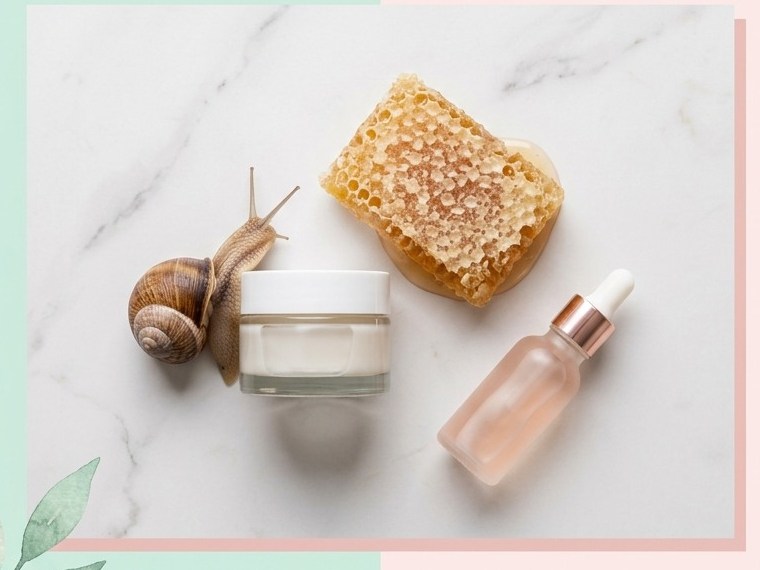
⚡ The 30-Second Version
- ✓Some of the strangest-sounding ingredients have real clinical data: bee venom cut wrinkle depth in a 12-week study, snail mucin has 100,000+ user reviews behind its glass-skin reputation, and fermented (galactomyces/rice) extracts genuinely brighten.
- ✓The 'ick factor' has nothing to do with whether an ingredient works — bee venom is a signaling molecule, snail mucin is a cocktail of glycoproteins and hyaluronic acid, and fermentation just breaks big molecules into skin-usable pieces.
- ✓Weird ≠ risky-free: bee venom can trigger reactions in anyone allergic to bee stings, so patch test first and skip it entirely if you've ever had a serious sting reaction.
- ✓You don't need the weird stuff to have great skin — but if a bizarre ingredient has real studies behind it, that's very different from a gimmick with only a cool label.
You flip over a trendy Korean serum, read the ingredient list, and stop cold. Snail mucin. Bee venom. Fermented yeast filtrate. Horse oil. Bird's nest extract. Your first, completely reasonable reaction is: what am I about to put on my face, and why does the beauty aisle suddenly sound like a witch's pantry? It's easy to write the whole category off as gimmicky K-beauty weirdness designed to go viral on TikTok. But here's the twist that makes this genuinely interesting — some of these bizarre-sounding ingredients have real, peer-reviewed clinical data behind them, while others really are just a strange label slapped on an ordinary moisturizer. The trick is knowing which is which.
The 'ick factor' of an ingredient tells you absolutely nothing about whether it works. Your skin doesn't know or care that a molecule came from a snail or a bee — it only responds to the molecule's actual structure and what it does at the cellular level. So let's do the fun thing: go through the weirdest ingredients on the shelf, one by one, and separate the ones with legitimate science from the ones riding on shock value alone.
It helps to know why the beauty aisle got so strange in the first place. A lot of these ingredients come from Korean and broader Asian beauty traditions, where fermentation, animal-derived actives, and botanical extracts have long histories of use — and where the industry has been unusually willing to experiment and put oddball heroes front and center on the label. When those products went global and viral, the weirdness became a feature, not a bug: an ingredient that makes someone stop scrolling and say 'wait, snail WHAT?' is free marketing. That's great for virality, but it also means the shock value and the actual efficacy got tangled together, and untangling them is exactly the skill worth having.
Bee venom: 'nature's Botox' — and it's not entirely hype
Bee venom is the poster child for weird-but-studied. The pitch sounds absurd — smear diluted bee sting on your face — but the mechanism is real. Bee venom's main active, a peptide called melittin, appears to gently irritate the skin in a controlled way that boosts local circulation and stimulates collagen and elastin production, which is roughly the logic behind why it gets marketed as 'nature's Botox.' Crucially, that nickname is misleading (it does not paralyze muscles the way botulinum toxin does), but the anti-aging part isn't invented from nothing.
In a 12-week clinical study published in Clinical Interventions in Aging, a bee-venom serum measurably improved facial wrinkles — decreasing total wrinkle area, total wrinkle count, and average wrinkle depth, tracked with imaging over the full treatment period (Han SM et al., 2015). Broader reviews of bee venom in dermatology describe genuine anti-inflammatory and antibacterial properties from its peptide components, with potential applications spanning acne to photoaging. That's a real evidence base — modest, but real.
The honest caveat is a big one: bee venom is an allergen. If you are allergic to bee stings — especially if you've ever had a serious reaction — you should not put bee venom on your face, full stop. And even for everyone else, because it works by mild irritation, it's not the right pick for very reactive or rosacea-prone skin. Patch test on your jaw for a few days before it goes anywhere near your whole face. Weird-with-science still means respect the risks.
Snail mucin: the glass-skin cult favorite that's mostly legit
Snail mucin (snail secretion filtrate) is probably the most famous 'gross' ingredient in skincare, and it has earned an enormous following for a reason. That slimy filtrate is actually a rich cocktail of glycoproteins, hyaluronic acid, glycolic acid, zinc, and antioxidant peptides — a naturally occurring blend of humectants and repair molecules. In practice, it behaves like a lightweight, layerable hydrator that leaves skin looking plump and glassy, which is exactly the 'glow' people chase. The single most popular snail essence on the market carries well over 100,000 reviews, and that kind of repeat-purchase loyalty is its own kind of real-world evidence.
Is snail mucin a miracle? No — the peer-reviewed clinical literature on it specifically is thinner than the marketing implies, and most of its benefits are best described as excellent hydration plus a bit of gentle support for the skin barrier, rather than dramatic anti-aging. But 'a genuinely nice, well-tolerated hydrator that a hundred thousand people keep rebuying' is a perfectly good thing for an ingredient to be. It comfortably clears the bar of weird-but-worth-it, mostly on the strength of hydration and tolerability rather than any single blockbuster study. We've written separately about the deeper science of snail mucin if you want the full breakdown.
Fermented ingredients: the 'wine of skincare' that actually makes sense
Here's a category that sounds like marketing nonsense but has surprisingly logical chemistry behind it: fermented skincare. Galactomyces ferment filtrate, fermented rice water, saccharomyces (yeast) filtrates — the buzzword 'fermented' shows up on countless K-beauty essences and toners. The reason it isn't pure fluff is that fermentation genuinely changes ingredients. The process uses microbes to break large molecules down into smaller ones that skin can actually absorb, and it can generate new beneficial byproducts like amino acids, peptides, and antioxidants in the process. In other words, fermentation is a real chemical transformation, not just a nice word.
Fermented rice and yeast extracts are most associated with a brightening, smoothing, 'my skin looks more even' effect, and rice-based ferments are a backbone of a lot of gentle Korean brightening products. The evidence here is more mechanistic and traditional than blockbuster-trial-level, so calibrate expectations to 'nice glow and gentle brightening over weeks,' not 'erases dark spots.' But the underlying idea — that fermenting an extract makes it more bioavailable and adds useful byproducts — is sound. A rice-and-probiotics-based product is a very approachable place to meet this category, often bundled with other benefits like sun protection.
The ones that are mostly vibes: horse oil, bird's nest, and friends
Now the fun part — the ingredients that are weird primarily for the sake of being weird. Horse oil (yes, rendered fat from horses) is marketed as a rich occlusive moisturizer, and it does moisturize... exactly like any other emollient oil would. There's nothing magical about the horse part; it's a heavy moisturizing fat, and a jar of plain shea butter or a ceramide cream does the same barrier-sealing job without the ick factor. Similarly, 'swiftlet bird's nest extract' sounds exotic and luxurious, but the evidence that it does anything special on skin beyond generic hydration is essentially absent. These are cases where the strangeness is the entire selling point.
This is the real lesson of the weird-ingredient aisle: novelty is not evidence. An ingredient sounding shocking, rare, or exotic is a marketing strategy, not a mechanism. When you see a bizarre hero ingredient front-and-center on the label, the question to ask is never 'how unusual is this?' — it's 'what does it actually do, and is there anything backing that up?' Bee venom, snail mucin, and fermented extracts pass that test to varying degrees. Horse oil and bird's nest mostly don't; they're ordinary functions wearing an exotic costume.
Propolis and centella: the 'weird' ingredients that are quietly among the most useful
Two more oddball-sounding ingredients deserve a spot in the effective column, because they're both bizarre-adjacent and genuinely excellent. Propolis is the resinous 'bee glue' that bees produce to seal and sterilize their hives — which is exactly why it works on skin. That same antibacterial, protective function translates into soothing, calming, and mildly antimicrobial benefits for irritated or blemish-prone skin, and propolis-based ampoules and toners have become quiet staples for people with sensitive, breakout-prone complexions. It's the kind of ingredient that sounds like a novelty but behaves like a workhorse.
Centella asiatica — often labeled 'cica,' or by its actives madecassoside and asiaticoside — is another one that reads as trendy-exotic but has a legitimately impressive résumé for calming inflammation and supporting the skin barrier and wound healing. It's a mainstay of soothing, barrier-repair products for a reason: the calming, anti-redness effect is one of the more reliable in the gentle-skincare category. If bee venom is the flashy, high-risk-high-reward member of the weird family, propolis and centella are the dependable ones you can hand to almost anyone, including reactive skin, with very little downside. The lesson repeats: 'unusual origin' and 'gentle, well-tolerated, effective' are not opposites.
A word on 'natural,' because weird ingredients love to hide behind it
There's a psychological trap lurking under this whole category, and it's worth naming directly: strange, plant- or animal-derived ingredients get mentally filed under 'natural,' and 'natural' gets mentally filed under 'safe and gentle.' Neither leap is reliable. Bee venom is entirely natural and also a potent allergen. Essential oils are natural and among the more common causes of irritation and contact allergy in skincare. Meanwhile, some of the gentlest, most rigorously tested ingredients in existence — like the synthetic humectants and lab-made ceramides that quietly do the heavy lifting in barrier repair — are about as far from 'foraged in a forest' as you can get. Your skin responds to what a molecule does, not to its origin story.
So when you're evaluating a weird hero ingredient, mentally strip away both the 'ew, gross' reaction and the 'ooh, natural' halo, because both are noise. The exotic snail or the ancient fermented rice or the rare bird's nest is neither automatically suspect nor automatically wholesome. It's just a set of molecules, and the only questions that matter are the boring, powerful ones: what does it do, is there evidence it does it, and could it irritate my particular skin? Get comfortable ignoring the vibe and reading the mechanism, and the entire beauty aisle — weird corner included — stops being able to manipulate you.
How to shop the weird aisle without getting played
So how do you enjoy the genuinely fun, effective side of unusual skincare without falling for the gimmicks? A few simple rules make the whole category navigable. First, check what the weird ingredient is supposed to do and whether that claim is specific. 'Bee venom to stimulate collagen and reduce fine lines' is a specific, testable claim with some backing. 'Bird's nest for radiance and vitality' is a vibe. Specific, mechanism-based claims are the green flag; vague luxury-adjacent words are the yellow one.
Second, look at where the weird ingredient sits in the formula and what it's paired with. A snail essence that's mostly snail filtrate plus hyaluronic acid and a good humectant base is doing real hydrating work regardless of the novelty. A cream where 'bird's nest extract' appears near the bottom of the ingredient list — below the water, glycerin, and silicones actually doing the moisturizing — is selling you an ordinary moisturizer with an exotic sticker. The supporting cast often matters more than the headline oddity.
Third, respect the allergy and irritation angle, because 'natural' and 'weird' both get mentally filed under 'gentle,' and neither is guaranteed to be. Bee venom is the clearest example — a genuinely bioactive ingredient that is also a genuine allergen. Anything derived from an animal or an active peptide deserves a proper patch test: a small amount on your inner forearm or jaw for a few days before you commit it to your whole face. This is doubly true if you have sensitive, reactive, or allergy-prone skin.
So... should you try the weird stuff?
If you're curious, absolutely — with the right expectations. Snail mucin is a lovely, well-tolerated hydrator that a huge number of people genuinely love, and it's a low-risk, high-satisfaction entry point into the category. Fermented rice and yeast essences are a gentle, sensible way to chase a brightening glow. Bee venom is the most 'active' of the bunch and the one to treat with the most caution: real data, real results for some people, and a real allergy risk that means patch testing isn't optional. And the pure-novelty ingredients? You can safely skip them and not miss a thing.
The bigger takeaway goes beyond any single strange serum. The weird-ingredient aisle is a perfect little test of skincare literacy: it teaches you to ignore how shocking or exotic something sounds and ask the only question that matters — what does this molecule do, and is there evidence it does it? Get that habit down, and you'll navigate not just the witch's-pantry shelf but the entire skincare market with a lot more confidence and a lot less money wasted on beautifully packaged nonsense.
The bottom line: some of skincare's weirdest ingredients are weird and effective (bee venom, snail mucin, fermented extracts), and some are weird and pointless (horse oil, bird's nest). The strangeness never tells you which is which — the mechanism and the evidence do. Shop the science, not the shock value.
Heads up: links below are affiliate links — we may earn a small commission at no extra cost to you. Learn more.
🛒 Featured in this post
 -26%Amazon
COSRX Snail Mucin 96% Repairing Essence (100ml)
The 105,000-review K-beauty icon. Featherweight glass-skin hydration that layers under everything.
 Amazon
Beauty of Joseon Relief Sun Rice + Probiotics SPF50+
TikTok-viral Korean sunscreen praised for its no-white-cast, lightweight finish.
📚 Sources & studies
- Han SM et al., Clinical Interventions in Aging (2015) — The beneficial effects of honeybee-venom serum on facial wrinkles in humans (12-week clinical study) View study ↗
- Wehbe R et al., Toxins / MDPI (2019) — Potential Therapeutic Applications of Bee Venom on Skin Disease and Its Mechanisms (literature review) View study ↗
This article is for informational purposes only and is not medical advice. Skincare products affect individuals differently — consult a board-certified dermatologist for concerns about your skin.