Centella Asiatica (Cica): The K-Beauty Soothing Ingredient With Real Trial Data
⚡ The 30-Second Version
- ✓Centella asiatica ('cica') contains triterpenoid compounds — asiaticoside and madecassoside — that signal skin cells to produce more collagen and calm inflammation.
- ✓The strongest evidence: a split-face, double-blind, randomized trial on post-laser wounds found a standardized centella extract measurably improved healing versus placebo on the same person's face.
- ✓It's genuinely suited to barrier-compromised, reactive, or post-procedure skin — not just a K-beauty buzzword.
- ✓Look for it paired with panthenol or ceramides in a barrier-repair formula, not necessarily as the star of an active-heavy serum.
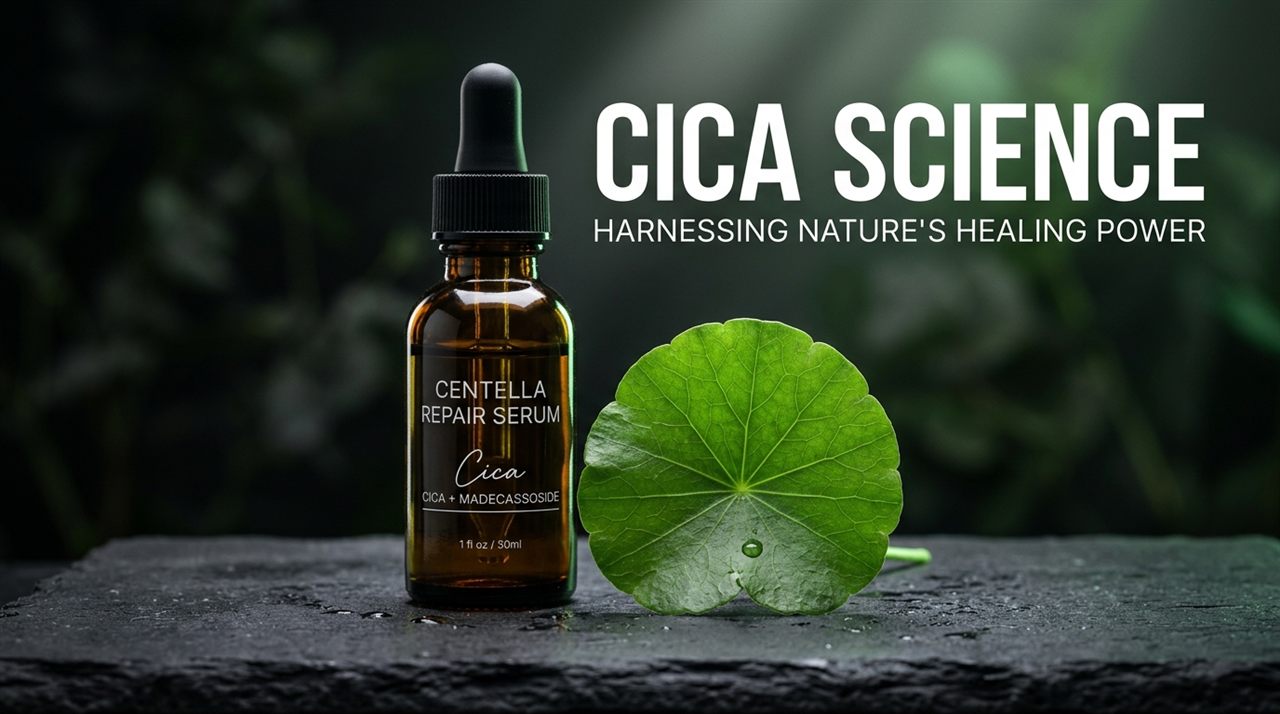
"Cica" — short for Centella asiatica, sometimes called tiger grass or gotu kola — is one of the most common ingredients in Korean skincare's soothing and barrier-repair category. It's the kind of ingredient name that gets stamped on packaging so often it starts to sound like marketing filler. In this case, there's a real, published clinical trial behind the claim.
What's actually in the plant
Centella asiatica contains a family of triterpenoid compounds — principally asiaticoside and madecassoside — along with their acid forms (asiatic acid, madecassic acid). These compounds act on skin through more than one pathway: they help signal fibroblasts to produce more collagen (via the TGF-β/Smad pathway, the same general family of signaling involved in wound repair), and separately, they calm the inflammatory signaling (NF-κB) that drives redness and irritation. That dual action — pro-collagen and anti-inflammatory at once — is what makes centella genuinely different from a plain calming agent like aloe.
The trial that backs it up
The strongest piece of evidence is a split-face, double-blind, randomized, placebo-controlled trial in people recovering from Er:YAG laser resurfacing — a genuinely aggressive form of skin injury. Half of each participant's face received a standardized 0.05% centella asiatica extract gel, and the other half received a placebo gel, so each person served as their own control. The centella side showed measurably better wound healing than the placebo side. That's about as clean a real-world stress test as a soothing ingredient can get: actual injured skin, randomized, blinded, and compared directly against a placebo on the same face.
Who should actually use it
Centella's real strength is for skin that's currently compromised — post-procedure (like the laser trial), post-sunburn, reactive to a new retinoid or acid, or just chronically sensitive. It's less of a headline anti-aging active and more of a barrier-support ingredient you layer in specifically when your skin needs to calm down and rebuild. That makes it a natural pairing with panthenol (vitamin B5) or ceramides, and a smart choice to keep on hand for the recovery nights of a skin cycling routine or after a stronger exfoliating session.
How to shop for it
Look for centella asiatica, Centella asiatica extract, asiaticoside, or madecassoside listed reasonably high in the ingredient list — not buried at the bottom in trace amounts. It shows up in Korean cleansing oils, barrier balms, and ampoules; a centella-based cleansing oil is also a genuinely good pick for the first step of double cleansing if your skin reacts to typical oil cleansers.
The bottom line: centella asiatica isn't just a soothing buzzword — a real split-face RCT on actual wound-healing skin backs up its reputation. Reach for it specifically when your skin barrier needs to recover, not as a general-purpose anti-aging serum.
Heads up: links below are affiliate links — we may earn a small commission at no extra cost to you. Learn more.
🛒 Featured in this post
 Amazon
SKIN1004 Madagascar Centella Light Cleansing Oil
A gentle, centella-infused Korean cleansing oil built specifically for the double-cleanse's first step.
 Amazon
La Roche-Posay Cicaplast Balm B5
A derm-brand barrier-repair balm with centella asiatica and shea butter — occlusive enough for slugging, gentle enough for irritated skin. 22,000+ reviews.
📚 Sources & studies
- Randomized, Double-Blind, Placebo-Controlled Trial, PMID 32310680 — The Effects of a Standardized Extract of Centella asiatica on Postlaser Resurfacing Wound Healing on the Face (split-face design) View study ↗
This article is for informational purposes only and is not medical advice. Skincare products affect individuals differently — consult a board-certified dermatologist for concerns about your skin.