Your Body Deserves Retinol Too — But Does the Evidence Back It Up?
⚡ The 30-Second Version
- ✓Body retinol creams and AHA/lactic acid body lotions are being marketed with face-serum-level actives — the 'skinification of body care' trend.
- ✓The AHA side has strong, decades-old evidence: a classic randomized trial found 12% ammonium lactate lotion significantly outperformed a lower-strength lactic acid lotion for treating moderate-to-severe xerosis (dry, rough skin).
- ✓The retinol side is honestly thinner — most of the strong tretinoin/retinol trial data is facial photoaging research; body-specific retinoid evidence exists but is much more limited.
- ✓Practical takeaway: for rough, dry, or bumpy body skin (including keratosis pilaris), the AHA/lactic acid evidence is the stronger bet; treat body retinol as promising but less proven than its face-cream reputation implies.
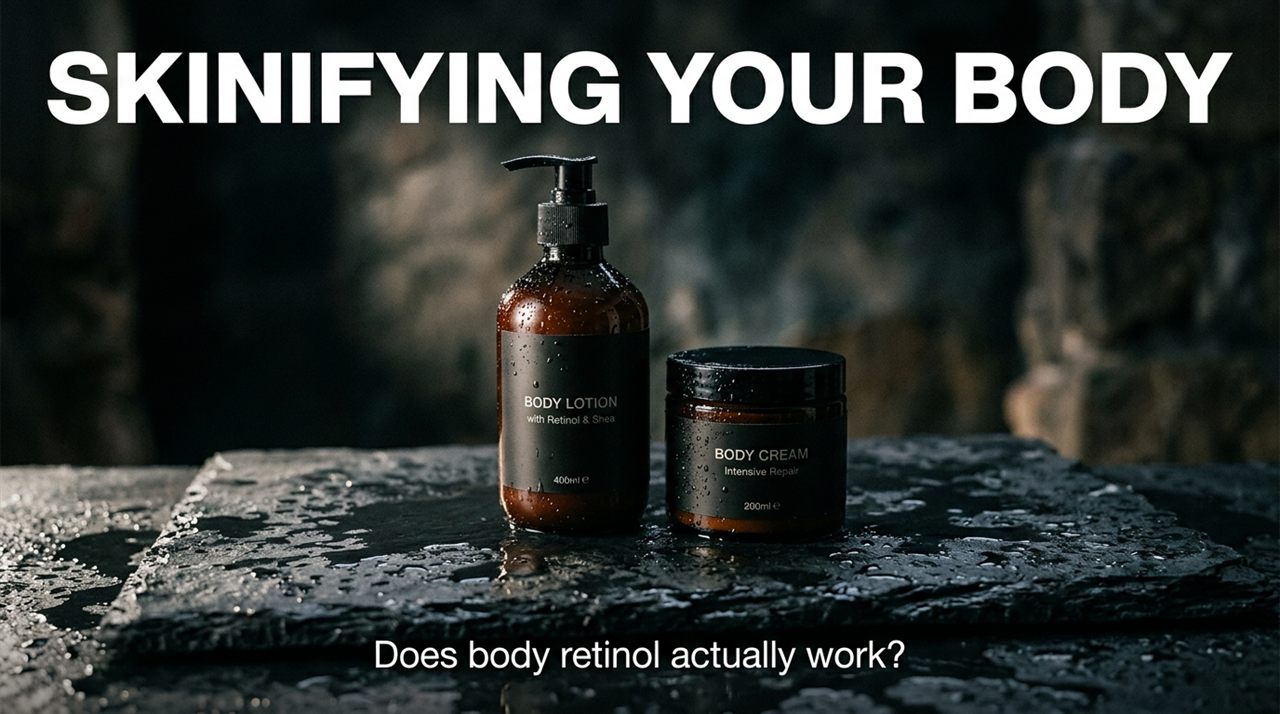
For years, the serious actives stayed on the face and the body got whatever moisturizer was cheapest at the drugstore. That's changed — body retinol creams and AHA-based body lotions are now marketed with the same specificity and price point as facial serums, aimed at crepey skin, keratosis pilaris, body acne, and general roughness. The question worth asking before you pay face-serum prices for a body product: does the evidence actually support treating your body like your face?
The AHA side: genuinely strong, decades-old evidence
This is the part of the trend with real trial data behind it, and it's not new — it's just newly marketed. A landmark randomized, double-blind trial compared 12% ammonium lactate lotion against a lower-strength 5% lactic acid lotion in patients with moderate-to-severe xerosis (dry, rough body skin). The 12% ammonium lactate formulation was significantly more effective at reducing xerosis severity over a 3-week twice-daily treatment period — and the improvement held up through a 3-week no-treatment follow-up, meaning the benefit wasn't just temporary surface smoothing that vanished the moment you stopped. This is the actual science behind the AmLactin-style 12% ammonium lactate lotions that have quietly been effective for decades, now repackaged into the 'skinification' conversation.
The retinol side: the evidence gap that's worth knowing
This is where honesty matters most. The overwhelming majority of strong retinoid trial data — the studies showing measurable collagen synthesis, wrinkle reduction, epidermal thickening — is facial photoaging research. Dedicated body-retinoid trials are much thinner. The most directly relevant one, a study on tazarotene cream for keratosis pilaris, was presented as a conference poster abstract rather than a full peer-reviewed paper, which is a meaningfully lower evidence tier than the randomized trials behind facial retinoid claims. That doesn't mean body retinol does nothing — the mechanism (increased cell turnover, collagen stimulation) is the same biology whether it's applied to your cheek or your thigh — but the specific claims on body-retinol packaging often lean on face-skin trial data that wasn't actually tested on body skin.
What this means for which product to reach for
If your main complaint is rough, dry, bumpy skin — including classic keratosis pilaris on the upper arms — the AHA/lactic acid route has the stronger direct evidence behind it, and it's also the cheaper category: a 12% ammonium lactate lotion like MAJOR's Ammonium Lactate 12% Moisturizing Lotion runs a fraction of the cost of a designer body-retinol cream. If your goal is more about crepey texture or fine lines on body skin, a body retinol like Advanced Clinicals' Retinol Body Lotion is a reasonable, low-cost way to test the mechanism — just calibrate your expectations to 'plausible based on facial retinoid biology' rather than 'proven by body-specific trials the way ammonium lactate is.'
How to actually use either one
Start slow with body retinol the same way you would on your face — every third night, working up to nightly as tolerated, since body skin can be just as reactive as facial skin even though it's thicker in some areas. Ammonium lactate lotion can be used daily on rough patches without the same ramp-up, though it can sting on broken or freshly-shaved skin, so apply it a few hours away from shaving.
The bottom line: body skincare going clinical is a real and partly evidence-backed shift — the AHA/lactic acid side has strong decades-old trial data, the retinol side is plausible but built on much thinner body-specific evidence than its face-cream reputation suggests. Choose based on what you're actually treating, not just which one sounds more advanced.
Heads up: links below are affiliate links — we may earn a small commission at no extra cost to you. Learn more.
🛒 Featured in this post
 Amazon
Advanced Clinicals Retinol Body Lotion & Face Moisturizer
A budget retinol body cream for crepey skin and fine lines beyond the face — the 'skinification of body care' trend in a bottle. 16,800+ reviews.
 Amazon
MAJOR Ammonium Lactate 12% Moisturizing Lotion
The exact 12% ammonium lactate formulation behind the classic xerosis trial data — hydrates and gently exfoliates rough, dry body skin. 3,400+ reviews.
📚 Sources & studies
- Rogers RS 3rd et al., J Am Acad Dermatol (1989) — Comparative efficacy of 12% ammonium lactate lotion and 5% lactic acid lotion in the treatment of moderate to severe xerosis View study ↗
This article is for informational purposes only and is not medical advice. Skincare products affect individuals differently — consult a board-certified dermatologist for concerns about your skin.